|
1
|
- (Doing things with language)
|
|
2
|
- Situation-based use of language
- The study of language use:
- The way language is used in communicative situations
- The way we interpret language utterances from context
- How we understand non-literal expressions
- How we plan and execute utterances to fit expectations, intentions,
context
|
|
3
|
- What the speaker/writer means or implies (vs. what s/he literally says)
- English: kill = cause + become + dead
- Conversational implicature: discourse obligations, (im)plausible
conclusions
- Philosophy, formal logic has much to contribute to this area
|
|
4
|
- Modus Ponens:
p à
q
p
--------
q
- Modus Tollens:
p à
q
Ø q
---------
Ø p
- Hypothetical syllogism:
p à
q
q à
r
--------
p à
r
- Disjunctive syllogism:
p v q
Ø p
--------
q
|
|
5
|
- DeMorgan’s Laws
- Ø(j v y) ó (Øj & Øy)
- Ø(j & y) ó (Øj v Øy)
- Conditional Laws
- (j ® y) ó (Øj v y)
- (j ® y) ó (Øy ® Øj)
- (j ® y) ó Ø (j & Øy)
- Biconditional Laws
- (j « y) ó (j ® y) & (y ® j)
- (j « y) ó (Øj & Øy) v (j & y)
|
|
6
|
- John regrets that he ate all the eggs.
- John is sorry that he ate all the eggs.
- John repents of having eaten all the eggs.
- John is unhappy that he ate all the eggs.
- John feels contrite about eating all the eggs.
- John feels penitent about eating all the eggs.
- John feels remorse for having eaten all the eggs.
- all presuppose:
- John ate all the eggs.
|
|
7
|
- *Behind [Mary]i [she]i heard the snake.
- *[Herself]i is proud of [her]i.
- *If [that jerk]i calls, tell [Tom]i I’m busy
tonight.
- *[He]i insists that [the electrician]i found
nothing wrong.
- [Mary]i told [John]j that [they]/j/i/k
were assigned clean-up duty.
|
|
8
|
- The man drinking Postum is Fred.
- The man who can lift this stone is stronger than an ox.
|
|
9
|
- Syntactic coreference principles (Binding Principles A-C,
φ-features, distance)
- The Hobbs algorithm: ordering of syntactically-derived potential
antecedents from previous utterances
- The centering algorithm: cache of 2-3 previous sentences, stack-based
memory, preference weighting among possible antecedents
|
|
10
|
- Discourse processing: interpreting language in its context
- Deixis: pointing to real-world entities
- Conversation and situation
- Beliefs, desires, intentions
- Turn-taking
|
|
11
|
- A: John’s cooking tonight.
B: Where’s the Alka-seltzer?
- I now pronounce you man and wife.
- A: Do you know what time it is?
B: *Yes.
- A: That was a great movie.
B: You can say that again!
A: *That was a great movie.
|
|
12
|
- Austin: “How to do Things with Words”
- Huge topic
- Psycholinguists, philosophers, anthro-pologists, literary critics,
lawyers, linguists
- While saying something, or after having said it, we DO (accomplish)
something with our utterance; “performatives”
|
|
13
|
- I bet you six dollars it will snow tomorrow.
- I hereby christen this ship the USS Clinton.
- I apologize.
- I therefore sentence you to 5 years hard labor.
- I bequeath you my 1830 edition of the BoM.
- I declare war on Iraq.
- I give you my word.
- I pledge my allegiance…
- *I hereby divorce you.
|
|
14
|
- Felicity conditions (else misfire [A,B], abuse [B])
- Must exist a conventional procedure, effects; situation and persons
must follow it
- Procedure must be executed correctly and completely
- Participants must have requisite thoughts, feelings, intentions;
subsequent conduct must be followed
|
|
15
|
- Preparatory conditions
- S is able to perform A (*May I breathe for you?)
- H wants S to perform A (*May I kill your cat now?)
- Sincerity conditions (S intends A)
- Propositional conditions
- S1 promise A è
S1 achieve A
- S1 request A è
S2 address R; accept/reject A
- S1 YNQ whether P è
S2 answer-if P
- Essential conditions (S obliged to do A)
|
|
16
|
- Locutionary act: uttering of the sentence
- Illocutionary act: whether making promise, offer, statement, etc.
- Perlocutionary effect: effects on hearer(s)
- Shoot him!
- It’s cold in here.
- Do you know what time it is?
|
|
17
|
- Close the door.
- I want you to close the door. I’d be much obliged if you’d close the
door.
- Can you close the door? Are you able by chance to close the door?
- Would you close the door? Won’t you close the door?
- Would you mind closing the door? Would you be willing to close the door?
- You ought to close the door. It might help to close the door. Hadn’t you
better close the door?
- May I ask you to close the door? Would you mind awfully if I were to ask
you to close the door? I am sorry to have to tell you to please close
the door.
- Did you forget the door? Do us a favor with the door, chap. How about a
bit less breeze? OK, Johnny, what do big people do then they come in?
|
|
18
|
- Quantity: be sufficiently verbose
- Not more/less informative than necessary
- Quality: be truthful
- Don’t say what you know is false or unsupported
- Relevance: be relevant
- Say only things that are relevant
- Manner: be perspicuous
- Say things unambiguously, clearly, briefly, orderly
|
|
19
|
- Purposely violating conventions;
carries conversational implicature
- Flouting relevance:
- A: Would you like some fresh brownies?
B: Is the pope Catholic?
- Flouting quantity:
- A: What are you reading?
B: A book.
- Flouting quality:
- Your are the cream in my Postum…
- Flouting manner:
|
|
20
|
|
|
21
|
- Pointing, indicating: context is indispensable
- Meet me here a week from now with a stick this big.
- Context:
- Speaker(s), addressee(s), utt-time, utt-place, indicated objects,
shared assumptions/knowledge
|
|
22
|
- Time: (I’ll be back in an hour. It’s now 12:13. There is a man on the
moon. This afternoon the Dow rose 24 points.)
- Place: (This city is really beautiful. The cat is behind the box. This
side of the box is red.)
- Person: (He’s not the duke, he is; he’s the butler. I’m Deryle. Are you
French?)
- Discourse: (Anyway, … / In conclusion, … / …the figure on the right. /
Still, … / That was the funniest story I ever heard.)
|
|
23
|
- Network of conceptual relations that underlie a text/conversation (Cf.
cohesion: surface relations)
- A subjective property of texts (Cf. cohesion: objective)
- Dependent on expectations and real-world experience, cultural background
|
|
24
|
- Discourse referents, zero anaphors
- Metric for ranking possibilities
- Very useful in pro-drop languages
- Referent tracking, anaphora
|
|
25
|
- Represent, track discourse entities (explicit and implicit)
- Predicate logic for deduction, inferencing, etc.
- Used in many dialogue, discourse analysis settings
|
|
26
|
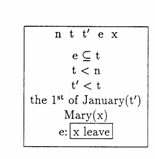
- Mary left on January 1st.
- n=now (utterance time)
- t=reference time
- t’=event time
- x=discourse entity
|
|
27
|
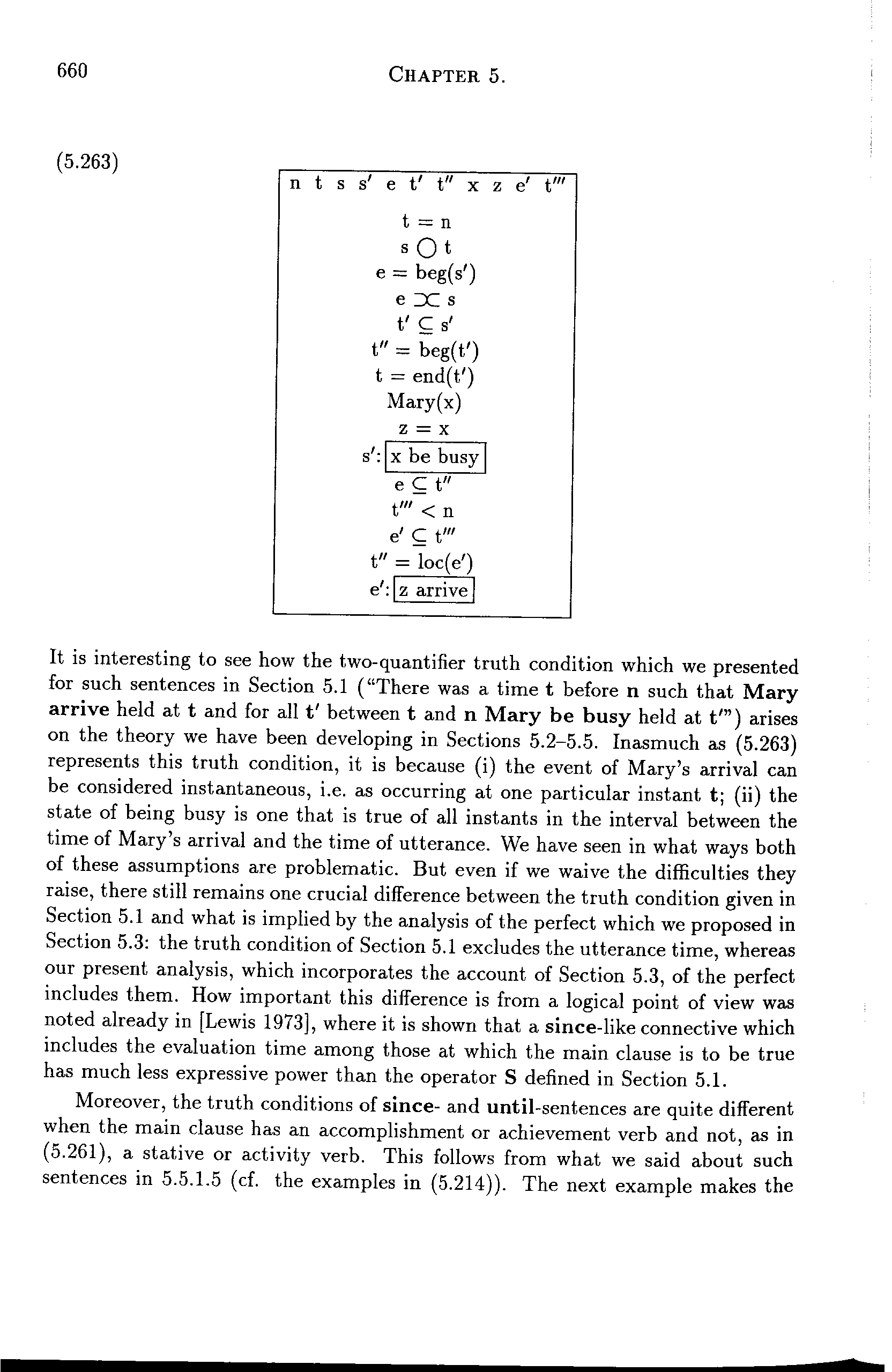
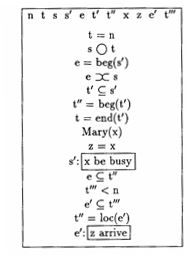
- Since she arrived, Mary has been busy.
|
|
28
|
- Analyzing dialogues
- Turn-taking, linguistic content, pauses
- Appointment scheduling, conference registration, travel planning (airlines)
- Annotating corpora
- Use in conversational systems (TRAINS, JANUS, VERBMOBIL)
- Active area in e-business, chatterbots
|
|
29
|
- utt1 : s: hello <sil> can I help you
- utt2 : u: yeah I want t- I want to determine the
maximum number of boxcars of
- oranges <sil>
that I can get to Bath <sil> by seven a.m. <sil>
- tomorrow morning
- utt3 : so <brth> hm <sil>
- so I guess all the
boxcars will have to go through oran- <sil>
- through Corning
because that's where the orange juice <brth>
- orange factory is
- utt4 : so from Corning to Bath how far is
that
- utt5 : s: two hours
- utt6 : u: and it's gonna take us also an hour to
load <sil> boxcars right
- utt7 : s: right + +
- utt8 : u: + okay + so <sil> hm so
<sil> every trip will take at least <sil>
- three hours
<sil> then
- utt9 : um
- utt10 : s: right we can unload
any amount of cargo onto a train in one hour
- utt11 : so we can +
<sil> do a maximum of three + boxcars in an hour
- utt12 : u: + right <sil>
okay +
- utt13 : okay <sil> so I
guess one thing we can do oh <brth> so <brth>
- I guess one thing is
that we should see how many boxcars we can actually
- get to Corning in four
hours
- utt14 : um how far is it from
Avon to Bath <sil> to Corning
- utt15 : s: <click>
<brth> that's six hours it's + shorter + through Dansville
- utt16 : u: + okay +
|
|
30
|
- E.g. action BUY(e):
- Roles: buyer, seller, object, money
- Constraints: Human(buyer), SalesAgent(seller), IsObject(object),
Value(money, Price(object))
- Preconditions: AT(buyer, Loc(seller)), OWNS(buyer,money),
Owns(seller,object)
- Effects: ~Owns(buyer,money), ~Owns(seller,object), Owns(buyer,object),
Owns(seller,money)
- Decomposition: GIVE(buyer,seller,money), GIVE(seller,buyer,object)
|
|
31
|
- Implication, entailment, presupposition
- Thematic presentation strategies
- Serialization strategies (addresses, lists of languages, etc.)
- Socio-cultural norms for language use (forms of address, taboo, etc.)
- Motivated deviation from pragmatic norms
|
|
32
|
- Computer programs (usually agents) that hold conversations with people
- Most limited to specific domains (e.g. Hampy)
- The Loebner contest
- “An average interrogator will not have more than a 70% chance of making
the right identification after five minutes of questioning” (1950)
- 6 c-bots, 4 humans (teacher, MBA, minister, yogi), 10 judges (linguist,
chemist, 2 phil’s, musician, psych’ist, journalist, u’grad, author,
grad)
- 91% correct after 5 minutes, 93% after 15
- No computer was mistaken for a human.
|
|
33
|
- A: I like techno, especially retro-electronic like Kraftwerk. I like
70's bands like ABBA. Also I like Opera.
- J: ALICE LIKES ABBA
- A: That's me. My favorite group is Kraftwerk.
- J: FIGURES
- A: No but I know a lot of female humans.
- J: DO YOU SPEAK ANY SWEDISH
- A: I speak only English right now, but I'd like to learn some other
languages. Can you teach me a few phrases in Any Swedish.
- J: SURE
- A: OK let's do it. Tell me more.
- J: SWEDISH FOR COMPUTOR IS DATOR
- A: How do you usually introduce yourself?
- J: WOMAN IS KVINNA SO I GUESS YOU ARE A KVINNLIG DATOR
- A: What do you look like?
- J: I LOOK TONS DIFFERENT FROM YOU
- A: You sound very attractive.
- J: HOW WOULD YOU DESCRIBE YOURSELF BY THE WAY
- A: It is a good question. Let me think about it. I can ask someone about
it.
|

 Notes
Notes